Sunday, October 31, 2010

Greek Pottery

When studying the bell krater it is easy to pick up on the fact that not only did ancient Greek pottery serve as a functional peice of work, but a decorative piece as well. All of ancienct Greek pottery is known to have been decorated in some form and it usually involves intricate work. This particular bell krater was used for mixing wine and water. It was made out of terracotta clay, which is a red colored clay. It was made around 440 B.C. by an artist known as Attic. It is also a red-figured piece, meaning that the figures were painted on in a red slip and details and the backgrounded were added on with a black slip. There are also black figured decorated peices, which are made using the opposite technique. On the obverse side there is a scene of Persephone going back to be with her mother, who happens to be the goddess Demeter and the reverse side is Libation scene. This is just one example of the scenes that would be depicted on these anceint works of art. Often times the scenes involved representations of the gods doing something of significance. Many other painted pots were decorated with the red figure technique. It allowed the artists to paint with greater detail and precision.

Greek pottery was created for a couple of purposes, but has been such a great documentation of history, that people study and reference it today in order to gain knowledge and understande about ancient Greek culture, Greek mythology and caftsmanship of the ancient Greek times. With the different shapes of the vessels and the different stories and ways of representing those stories, Greek pottery are not only functional and culturally significant they are beautiful works of art.

Saturday, October 23, 2010

PREZI!

http://prezi.com/0j3risnlgune/the-anachronism/
Here's our prezi presenatation! Enjoy!

Saturday, October 16, 2010

One of Goya's Drawings

Francisco de Goya is mostly famous for his paintings, however this drawing and wash of his was discovered and is entitled "Joy." I stumbled on an article about this picture and wanted to read about it because I love the simplicity of the space that is made in the drawing. It is composed of two pictures doing what appears to be a dance of some sort, or some kind of embrace. The figures are not completely realistic, but are more characatures or people. In the article is says that the meaning is unknown but to me it seems clear that it is about joy between two people who are very close, perhaps dear friends. The article says however that the two people are "swept off their feet in a state of rapture." The figures are floating in space and with the combinations of their body posture and expressions it seems to portray joy quite perfectly. The figures are not the most handsome of people but it is unimportant to their emotion, for in the drawing, they are living out their feeling of happiness and this is what seems to be important to the artist when creating this drawing. His pictures are captivating and I would love to have something like this hanging in my home to remind me or joy.

<http://www.artnews.com/issues/article.asp?art_id=3084&current=True>

The Anceint Greek Kore

The peice I chose to discuss is the ancient statue of the female Kore. The reason why it was so interesting to me is because it reflects a very stylistic form or ancient sculpture. Usually when someone thinks of ancient Greek sculpture one thinks of the stylized version of the "super human" human beings that are life-like yet enhanced muscles and the bodies with perfect deminsions. This sculpture however pre-dates that era of common ancient Greek sculpture. The smile also known as the "archaic smile" is a slight smile that is deffinatley a noticable smile, however it is not one that is necessarily nature or life-like looking. It suggests that the person is well and filled with life. It is unnatural looking but reflects the ancient Greek culture of people of health and happiness. The sculpture is also a bit stiffer than the other later Greek sculptures. This is characteristic of the time period it was built in as well, which was around the 6th century BCE. The later Greek sculptures have a more relaxed and natural body posture than this sculpture does here. The hair is also stylistic of the era in which it was sculpted. Overall this sculpture is very telling of how the artist viewed and tried to replicate human beings. It is not completely natural but has the aim of representing a human being. The smile, posture and hair all give clues to this. I find it especially interesting being an artist myself.

Sunday, September 26, 2010

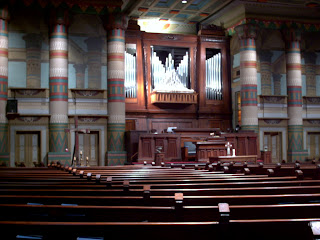
Downtown Presbyterian Church!


Visiting the downtown Presbyterian Church was quite an expereince. To have a "themed" church or a church decorated in a certain theme for a certain purpose is an interesting and foreign concept for me.  We have been discussing and reading in class how places of architecture give off certain feelings. I deffinately felt dwarfed when walking into this church. There were high ceilings with clouds painted on top to give the illusion of the sky, as well as width and depth that gave the space a very open feeling. I could image that sounds of worship in this building would carry well throghout the space. The church was also very stimulating, there were lots of color and decoration throughout the architecture of the church. For example, the stain-glass windows were decorated in an Egyptian theme with symbolic representations of ancient Egypt, such as blue water droplets symbolizing the Nile River. Another example was the illusion that the columns continued even after the actual 3D stuctures ended because of the trompe l'oeil effect of the painting on the wall. The temples of ancient Egypt were massive in size and were filled with rows of continuous columns. There were many geographical shapes throughout the architecture as well, reflecting ancient Egyptian decor. The actual site for the church made the inside of the church more intriguing because from the outside the building has the characteristics of a church and sits in downtown nashville among towering skyscrapers. No one would know that inside the church is another world, reflecting that of ancient Egypt. As far as the colors go, there were many, including: green, yellow, blue, red and more. The lighting in the church was someone dark, since it was a large church with only side windows, which were stain-glass. However the light that did come in through the windows was very beautiful because it came through the different colors of the window, which included bright blues, yellows, greens and more. The preservation of the church throughout time has been done well. The man who was there to show our class around mentionted that some of the paint it the origional paint from when it was first painted. Overal this expreience was very interesting and intriguing to see. I am glad that we visited this church because I probaly would not have known this existed otherwise.

Thursday, September 16, 2010

Art Review from New York Times!

Franz Xaver Messerschmidt was an 18th century German sculptor who is said to have had mental disturbances which came through in his art. Fascinatingly 19 of his sculptures have been grouped together for a show at the Louvre and travels from Paris to New York. The title of the show is “Franz Xaver Messerschmidt 1736-1783: From Neoclassicism to Expressionism.” Messerschmidt was a sculptor from a young age and by the age of 18 was admitted to a Fine Arts Academy in Vienna. He specializes in busts and portraits of people. He has even done a few busts that are self portraits. His portraits have captivated many over time because of thier extreme expressions. When asked by an interviewer once where he had drawn inspiration he admitted that there were spirits that tomented him and if he did sculptures of them it somehow helped the "spirits" stay subdued. I picked this article simply because the faces captivated me and I wanted to read more and learn more about what the faces were. This artist was known to be a bit crazy mentally and seems to have had disturbances that could not be subdued or reduced to simply nothing or something everyone experiences. Whatever his interactions were with "spirits" or however he was feeling or whatever he was seeing he made amazing sculptured busts of human faces with expressions that draw a viewer in. There is deffinately strong form, line and shape in his sculptures. The expressions in some of them are simple captivating and fun to look at. I enjoyed running into this article about this artist because in fact I had seen the peice before that I put up here but did not know who did it or about the artist so I'm glad to know now.

http://www.nytimes.com/2010/09/17/arts/design/17messerschmidt.html?_r=1&ref=arts

Work of Arte: The Nana Ziggurat

We talked briefly about the Nanna Ziggurat and I was captivated by it in a way. I am interested in places of worship and places were people hold religious ceremonies and traditions. In ancient times they were very much one of the central places of which a community surrounded. The ziggurat is pretty massive in size. It is made out of sun-dried mud brick. This place was also intriguing because it was a center for administrative activities in the city. This place obviously had political and religious significance and was the supposed place where the mood god had chosen to dwell. As far as aesthetics go it was a very solid structure with a sturdy and strong look to it. The walls are slanted upward so that the rain does not pool on the brick and become eroded and damaged quickly. From the appearance it almost looks like a war fort or something of the like. What is interesting is that the foundation has been built upon many times. Over time due to erosion the community would rebuild right on top of the foundation giving it a layered effect. The last time it was built upon was to reconstruct what it would have looked like back when it first existed. I found this aspect of the ziggurat very interesting because when I went to Israel this summer that is what they would do to the stone buildings and community structures there also, they would build upon the foundation after the top part had eroded away. I find that aspect to be quite symbolic of old structures. There is a foundation which is never taken away or destroyed but built upon year after year, which is sort of how history goes, as well as art, there are foundations and principals which will never leave and will always remain, but one part of history or art may fade away or crumble overtime, or even perhaps get lost but it is build upon nonetheless.